




The Survey You Could End Up Doing for Nothing

The Survey You Could End Up Doing for Nothing
Here is a question that should stop every surveyor in their tracks.
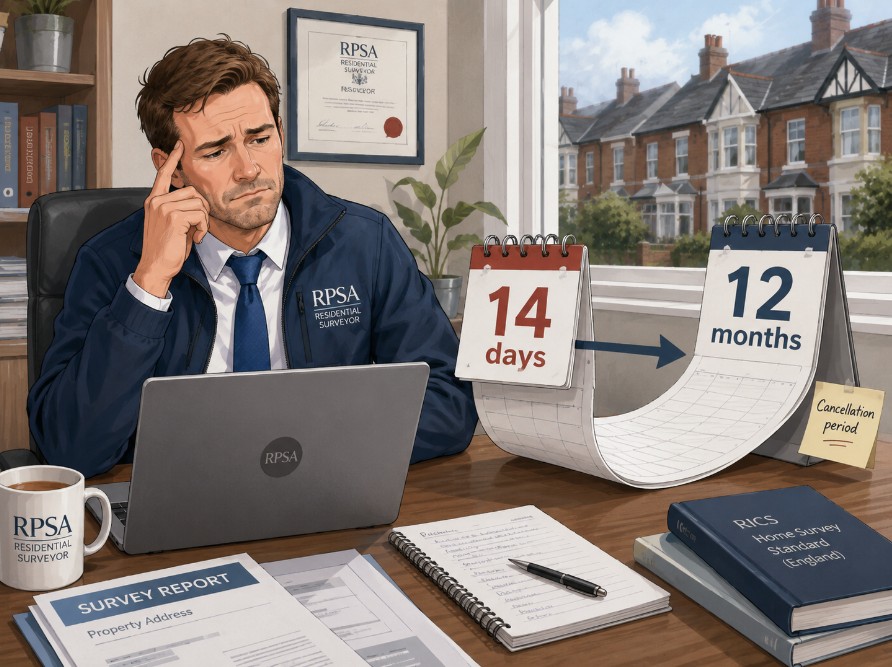
Did you know that if you fail to tell a client properly about their fourteen-day right to cancel, those fourteen days do not quietly expire?
It stretches to a full year.
For the next twelve months, your client can demand their money back, for no reason at all, even after you have carried out the survey and delivered the report. The work is done, the fee is gone, and there is nothing you can do about it after the event.
If you read one thing this year, make it this.
It started, as these things so often do, with something else entirely. I was researching a quite different question one evening when I came across the point above, read it again, put it into a search engine, and then checked it three more times to be sure I had understood it correctly. I had. And once I had, I did something I would gently suggest every member reading this might want to do for themselves. I went back through my own files.
Because the uncomfortable truth is this. If you have not been giving your clients their cancellation rights in the correct way, then in principle every consumer instruction you have taken in the last twelve months could still carry a live right to cancel and reclaim the fee. Not just this week's jobs. The surveys that are long finished. The reports that were read, paid for and acted upon months ago.
It is hard enough to make a living in this profession as it is, with the early starts, the long drives, the ladders, the lofts, and the responsibility we carry on every job. The thought that any of that work might, through nothing worse than not knowing a rule, turn out to have been done for nothing is a deeply unsettling one. It is exactly the kind of quiet, invisible vulnerability that sits in a great many honest, competent practices without anyone realising it is there.
Why this catches almost everyone
Most instructions reach us by email, by telephone or through a website. The client never sits across a desk from us in our office. In law that makes it a distance contract, and it gives the client fourteen days to change their mind for any reason at all. On its own that fourteen-day window is normal and manageable, and nothing to lose sleep over.
The fourteen days only behave themselves, though, if you have given the client the required cancellation information before the contract is made, in a form they can keep. Miss that one step and the clock does not even start. The window stretches out to as much as twelve months, and throughout that time the client holds the right to cancel and reclaim their money regardless of how much work you have done. This is not a loophole or a technicality waiting to be argued over. It is simply how the rules are written.
And even when you do it right
Now, suppose you do tell them. Good. But a survey is usually needed quickly, and few of us can afford to sit on our hands for a fortnight before lifting a finger. The moment you carry out the inspection within those fourteen days, you are working in a window during which the client can still walk away. The law does let you do the work and be paid for it, but only if you have first secured the client's clear request to begin early, together with their acknowledgement of what that means for their right to cancel. Get that in writing and you are protected. Skip it, and a client can let you complete the whole job and then cancel on day thirteen owing you nothing.
So there are two risks sitting side by side. The larger one is silence at the outset, which can quietly cost you a fee as much as a year later. The smaller, but very real, one is starting work inside the fourteen days without the right consent in place.
The moment it actually bites
Here is where it stops being theory. Ask yourself how many times you have surveyed a property only for the deal to fall apart afterwards. The buyer is gazumped. The seller has a change of heart and pulls out. A chain collapses two links away. It happens constantly, and most of the time it is nobody's fault.
But put yourself in the client's shoes at that moment. They have lost the house they wanted, and they are several hundred pounds out of pocket for a survey on a property they will now never own. It is only human when a purchase collapses, and money is suddenly tight, to look hard for any way of recovering an outlay. And if you never gave them their cancellation information, the law may hand them exactly that: your fee back in full, long after the work was done. A perfectly reasonable client, under real pressure, can quickly become a determined one, and in that situation, the rules will be on their side rather than yours.
This is precisely why the paperwork matters, and why it is worth a few minutes of attention at the start of every single job. Done properly, with the right cancellation information given and the early-start consent in place, it means that when a deal collapses, your fee is safe, because you carried out the work correctly and the client's cancellation right was used up the moment the report was delivered. Done carelessly, the collapse of someone else's transaction quietly becomes your loss.
The good news, and what we have done about it
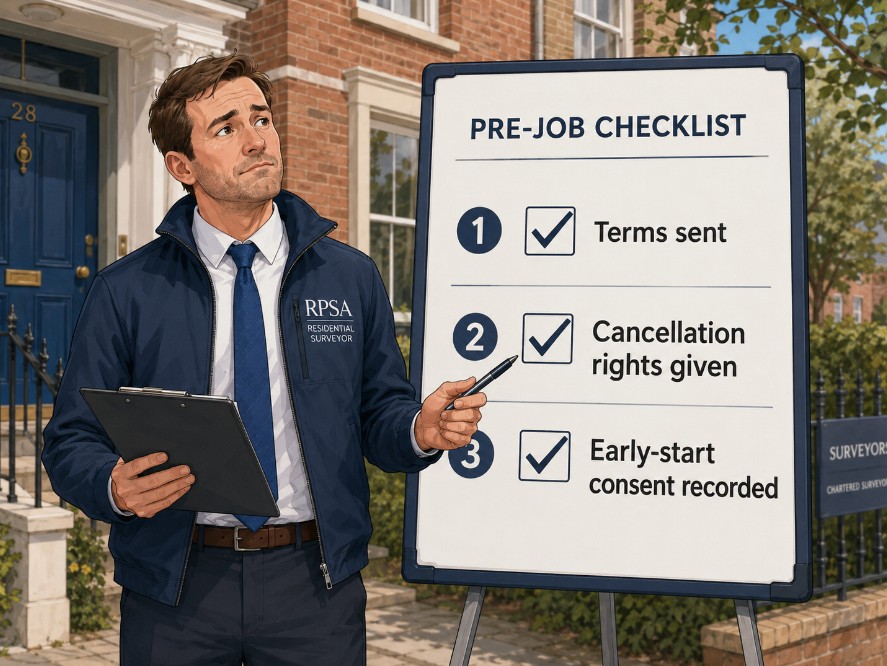
I am conscious this could read as a list of reasons to worry. It should not, because the remedy is genuinely simple. None of it is difficult, and none of it slows down a well-run practice. It is a habit rather than a hurdle, and a single, properly written booking confirmation, sent every time before any work begins, does very nearly all of it for you.
It is worth noting, too, that many members already issue the suggested RPSA terms, which clearly and correctly set out the fourteen-day cooling-off period. If that is you, a good deal of this is already quietly doing its job in the background, and this piece is not meant to suggest otherwise. It is simply a nudge to make sure the rest of the picture matches the terms: that they actually reach the client before the instruction is agreed, and that where a survey is to go ahead within the fourteen days, the client's consent to begin early is captured and kept on file. The terms set out the position; the small habits around them are what make it hold.
To make that habit easy to adopt, we have conducted thorough research and produced a new member document, CLI-02 Cancellation, Refunds and Consumer Rights Policy, which will be available in the Useful Documents area of the portal from 1st June 2026. It is a template you can use as is or adapt to your own practice. It explains the reasoning behind each rule rather than simply reciting the statute, and it gives you the tools to act on it: model wording to send to clients, a model cancellation form, a ready-made consent for starting work early, a simple decision aid for when a client does cancel, a set of worked examples drawn from real situations including the collapsed purchase, and a short self-assessment checklist you can keep as evidence of your CPD. It also draws the important line between a client who has simply changed their mind and one who is genuinely unhappy with the work, because those are two very different conversations with very different consequences for your professional indemnity cover.
This is the quiet, unglamorous competence that marks out a true professional, and it sits at the heart of the duty of care we owe our clients. Do take ten minutes to read it. It may well be the most valuable ten minutes you spend this month, and it could one day save you a fee you would otherwise have earned for nothing. And if you do one practical thing as a result of reading this, let it be this: set CLI-02 beside your own booking confirmation, your terms and your payment process, and put right anything that does not match before you accept your next consumer instruction.
CLI-02 is available now in the Useful Documents area of the RPSA portal.


